.png)
Fight or Flight (Sympathetic) Vs. Rest & Digest (Parasympathetic)

Our autonomic nervous system - the part that runs bodily functions - has two halves, Sympathetic (Fight or Flight) and Parasympathetic (Rest & Digest). They do very different jobs, and take turns being in charge. Sometimes, after a traumatic event or chronic stress, we can get stuck in the Sympathetic mode.
The Sympathetic response is more accurately called "Fight, Flight, Freeze, and Fawn" because all four are common reactions to acute stress.
Our daily activities, like sleep, damage repair, and digestion, are the job of the Parasympathetic half. This mode is supposed to be active the vast majority of our lives.
I like to use the example of zebras around a watering hole. They are chilled out, living their best zebra lives with their striped friends, until a lion shows up.

Then they leap into the Sympathetic mode for defense or running. This only lasts 15 minutes or so... the lion gets lunch, or doesn't, and leaves. The remaining zebras return to Parasympathetic-dominant mode. The threat is gone, and they go back to eating grass and drinking water again.
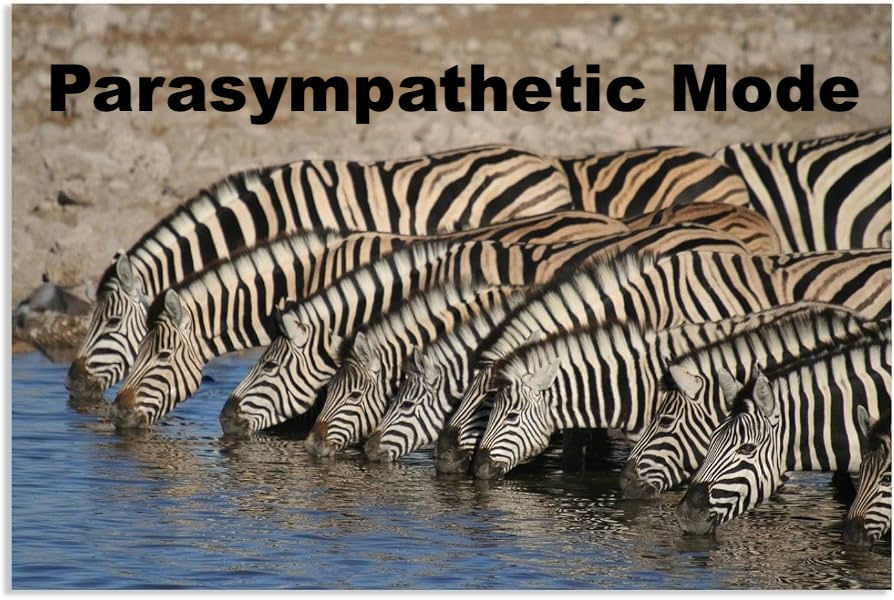
Humans are very silly. We tend to live more in the Sympathetic, thinking about past lions or future lions. This is important because the short-term emergency response is not meant to be sustainable. Our body and brain chemistry are very different in these modes.

When you're chronically stressed out, you feel on edge. Your immune system is not a priority, so you tend to get sick more often. A lack of digestive processing can create heartburn or even malnutrition in extreme cases. Increased cortisol contributes to fat gain. A lack of appetite can lead to unhealthy weight (muscle and bone) loss. We don't remember things we should. Our blood sugar and heart stress increase. We fall back on old bad habits, like getting fast food, instead of having the mental stamina to cook at home.
So what do we do about this?
The good news is that they work like a see-saw. Supporting one mode automatically suppresses the other. By supporting the calm Rest and Digest mode, we squash the Fight or Flight response.
We can learn to regulate our nervous systems and live more in the Parasympathetic with a series of grounding techniques and stress relief strategies. Eventually, our default shifts, and we can approach that ideal zebra lifestyle. :)
Everyone is different, so find the ones that work for you, and keep a list handy. When you need them, you probably won't remember, but checking that post-it or phone note will let you pick one that feels doable in the moment.
When you notice yourself getting anxious, use one or more of these strategies to regulate your nervous system and get grounded into the Parasympathetic again.
~ Light frequent movement (ideally, move every day), like a walk, bike ride, or dancing. If you are mobility limited, jut do what you can. Chair yoga or even snow angels in bed still count!
~ Observe your breathing (or do breathing exercises)
~ Think about a Happy Place (anyplace real or imagined where you feel safe and comfortable)
~ Try an app like Calm
~ Use The Eye Movement trick: Keeping your head still, move your eyes slowly back and forth, left and right. You can follow a series of objects, or have your eyes closed.
~ Touch a (consenting) person or pet to boost your oxytocin
~ Use ambient sounds (waves, rain, etc) and aromatherapy to sooth your mood.
~ Reprogram your brain with positive statements / mantras. "I am safe. I am relaxed. I can handle this." If that doesn't feel okay to say, try "I am learning to relax."
~Acupressure is fast and easy! I have full articles on PC6 and Shenmen. These plus Yin Tang and the Parasympathetic point on your ears are pictured below. All points are on both left and right. Press gently but firmly for a few seconds.
~ Long term, work on repairing your sleep.
~ Get outside. Sunlight, especially in the morning, improves your brain function and circadium rhythm. It's even more powerful when combined with movement.
Note: The Eye Movement trick is part of EMDR - (Eye Movement Desensitization and Reprocessing) - a great type of therapy if you have PTSD. Basically, it shunts you into Parasympathetic mode while reintroducing the trigger, so it breaks the connection to an alarm response. See a qualified therapist for more details.
The important thing is to stop the treadmill of winding yourself up. Deliberately change what you're thinking about, to something happy, something you are grateful for.
You might like the book The Body Keeps the Score by Bessel Van der Kolk for PSTD, or Self-Compassion: The Proven Power of Being Kind to Yourself by Kristin Neff.


As always, feel free to reach out if you have any questions!
Bonus technique: "Stroking the Dragon" stimulates the Parasympathetic Nerve roots on either side of the thoracic spine- where the ribs are. Don't go up into the neck or down into the lower back. Put a finger on either side of the spine and stroke along the red lines.


Comments