.png)
Modern science has finally caught up and found the Interstitium!

Updated: Jun 9
I've been saying for decades that acupuncture's meridian system works through a structure we don't have the technology to see yet ... and now we can! The interstitium is a pathway between layers of the body.
We knew that electricity travels along meridians.
Now they're calling that system the interstitium!
This Scientific Journal paper, Structure and Distribution of an Unrecognized Interstitium in Human Tissues lays out the original findings.
If you don't have an advanced scientific background, This article (by Avraham Z. Cooper, an associate professor of medicine at Ohio State University) in the New York Times has a strange format - they turned it into a dynamic graphic - but just keep scrolling down to get to the good stuff.
The TL:DR summary of the Interstitium:
Meridians as Fluid Pathways: Studies indicate that acupuncture meridians may correspond to channels of connective tissue where interstitial fluid flows, allowing signals to travel far beyond the local site of needle insertion.
Needle Grasp & Fascia: Acupuncture needles trigger a "needle grasp" effect, where connective tissue fibers (collagen) wrap around the needle, stimulating fibroblasts and encouraging structural remodeling of the fascia.
Cell Communication: The interstitial network aids in transmitting mechanical signals from needles into chemical signals (such as neurotransmitters), facilitating long-range communication within the body.
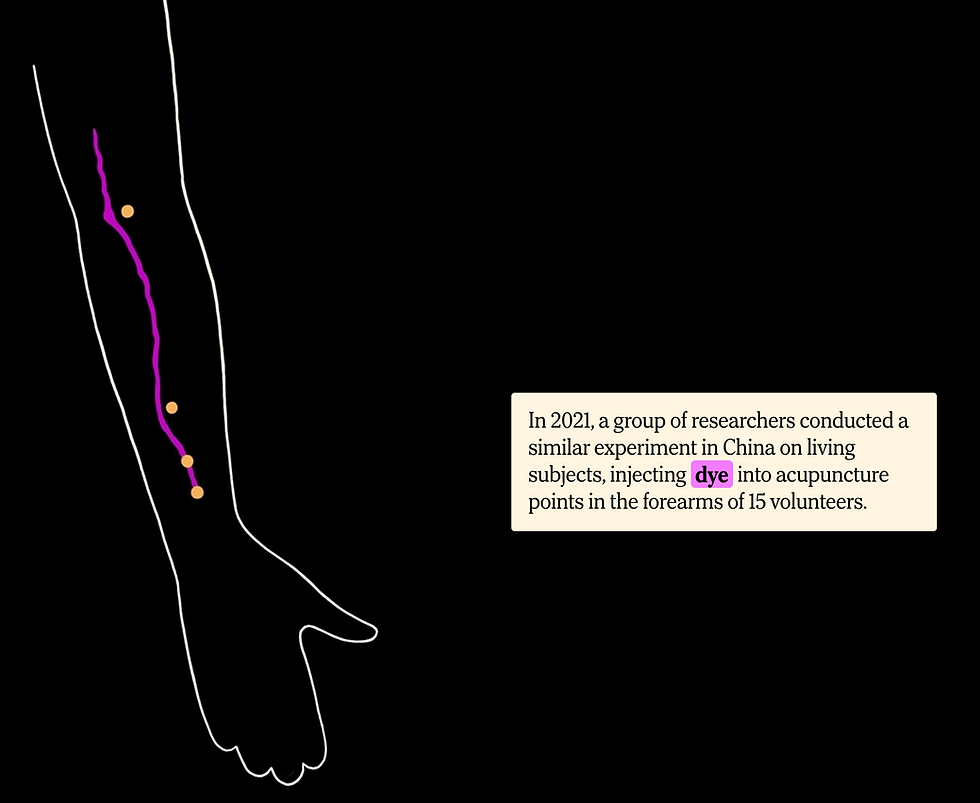
Visual Evidence: Research has shown that tracers injected into acupoints travel along known meridian routes, specifically within the interstitial space.
Functional Benefits
· Reduced Inflammation: Stimulation of the interstitium may help reduce inflammatory adhesions in the fascia.
· Improved Mobility: By relaxing connective tissue, acupuncture helps tissues regain mobility.
· Broad Physiological Effects: Interstitial flow transport supports the theory that acupuncture can trigger distant regulatory effects on organs by influencing fluid movement, rather than just acting locally on nerves.
This understanding bridges Traditional Chinese Medicine (TCM) with modern cellular anatomy, providing a tangible mechanism for how meridians interact with the body's structural systems. I'm so excited - hopefully this will help previously skeptical people get the care that will help them, without drug interactions or side-effects!


Comments